
Publications
2026:
[09] Phosphorescence of Heavy, T-Shaped Pnictogen Trisamides in Solution at Room Temperature in the Near-Infrared II Region
K. L. Deuter, S. Pavlidis, R. F. Winter*, P. Coburger*, J. Abbenseth*, Chem. Eur. J. 2026, e71049.
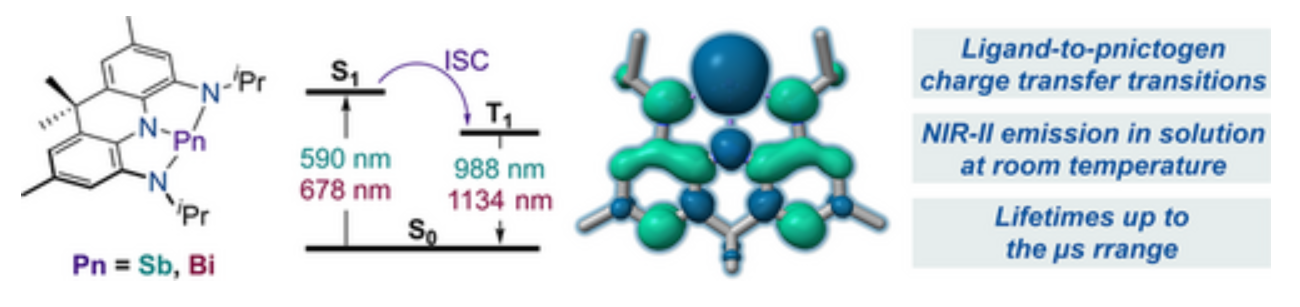
The unique photophysical properties of heavy T-shaped Sb and Bi trisamides are reported. A ligand-to-pnictogen charge-transfer excitation from a redox-active NNN pincer to a vacant pnictogen p-orbital populates a triplet state that emits in the highly desirable NIR-II region, with lifetimes up to the µs range. This represents the first example of Sb(III) and Bi(III) compounds showing NIR emission in solution at room temperature.
[08] Azobenzene-Functionalized Ionic Liquids: Light-Responsive Surfactants With Catalytic Potential
M. Hegelmann, S. Frei, J. Zuber, J. Luibl, W. Korth, A. Jess, P. Coburger, M. Cokoja*, ChemistryOpen 2026, 15, e70203. (shared first authorship between M. H. and S. F.)
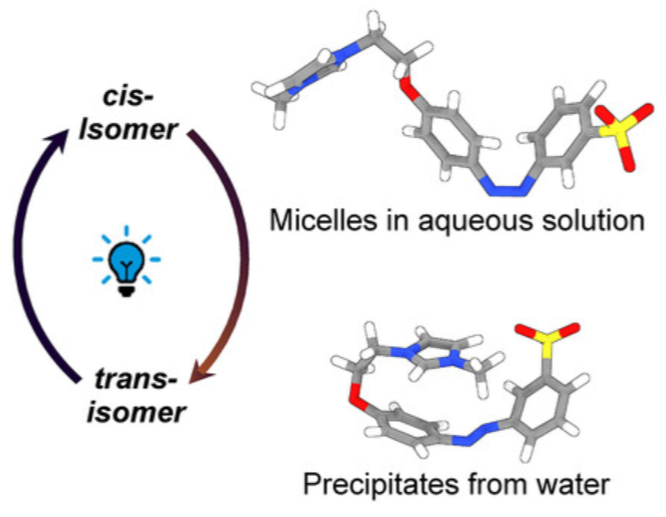
Surface-active imidazolium-based ionic liquids containing an azobenzene group exhibit different micellization properties upon photoisomerization. Applying a sulfonate tag to the azobenzene moiety profoundly affects the physicochemical behavior of both isomers in water. While the cis-isomer forms micellar aggregates, the trans-isomer is insoluble and precipitates. Such a behavior bears a perspective for the recycling of molecular catalysts attached to such surfactants.
[07] Modular Design enables Access to Onium-substituted Diphosphacyclobutadienyl Complexes
S. Frei, M. Neuwirt, P. Coburger*, CEUR. 2026, 4, e202500475.
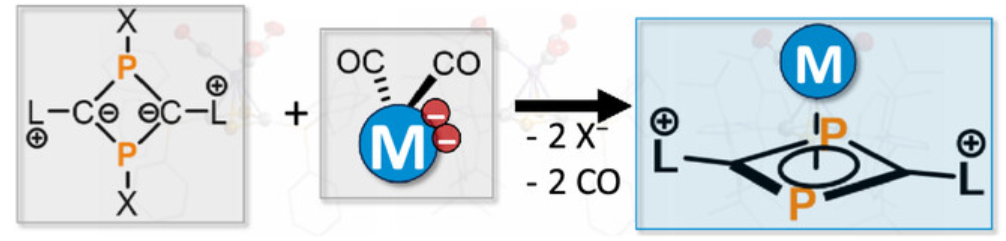
A modular synthetic approach affords a series of cationic cobalt and manganese carbonyl half-sandwich complexes bearing onium-substituted diphosphacyclobutadienyl ligands. In this strategy, the onium substituents are readily varied, and the cyclobutadienyl ligand is assembled in situ within the metal coordination sphere. The resulting complexes provide a platform to systematically study the properties and reactivity of these unique ligands.
2025:
[06] π-Complexes of Main-Group Metal Cations: Exploration of Lewis Acid Reactivity
D. Zuber, S. Frei, P. Coburger*, CEUR. 2025, 3, e202500199 (front cover).
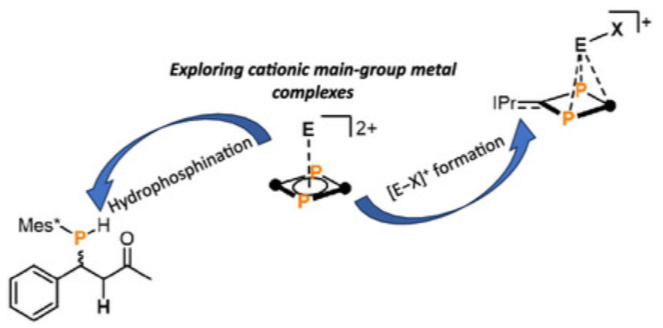
A series of cationic main-group complexes was obtained using the neutral, zwitterionic ligand IDP. The Lewis acidity of these complexes is explored by catalytic hydrophosphinations and halide addition reactions. The latter allow for the isolation of unusual π-complexes of tetryliumylidenes.
2024:
[05] Redox-induced Dimerisations of a phosphacyclic Biradicaloid
D. Zuber, O. Storcheva, K. P. Lüdtke, L. Brunk, P. Coburger*, Chem. Commun. 2025, 61, 2798-2801.
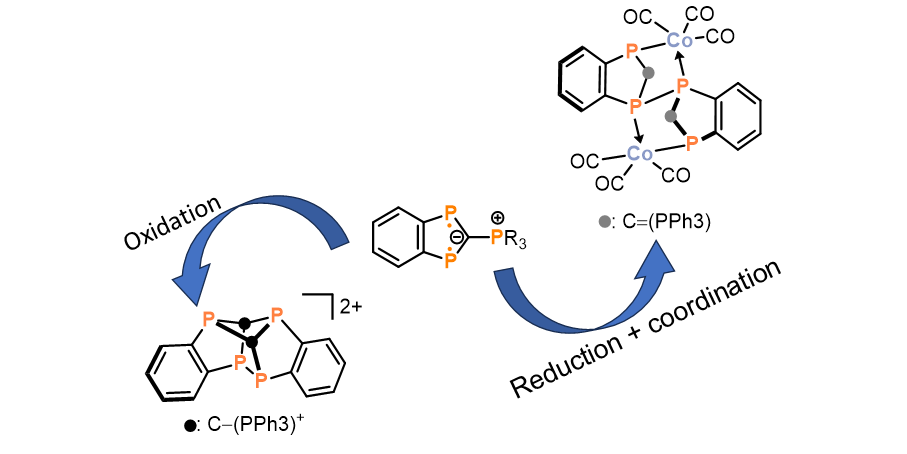
Reduction and oxidation of a phosphacyclic biradicaloid leads to reactive radical species which undergo selective dimerisation reactions.
[04] On the role of aurophilic interactions in determining geometries in [Pn(AuL)4]+ complexes (Pn = N, P, As)
P. Coburger,* T. Hadlington,* ZAAC 2024, e202400198 (dedicated to H. Schmidbaur on the occasion of his 90th birthday).
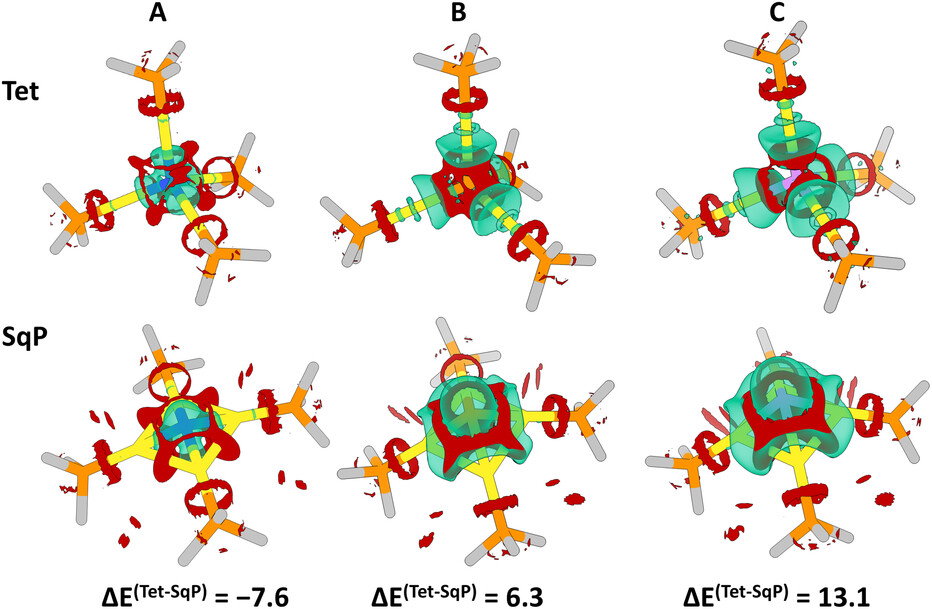
A computational inspection of the bonding in clusters [Pn(Au·PMe3)4]+ (Pn = N–As) is presented. This ultimately finds that aurophilic interactions play a significant role in the switch from a tetrahedral to a square-pyramidal geometry for P and As, the closer Au···Au contacts in this conformer amounting to ≈15 kcal mol−1 stabilization energy, overcoming strong P/As3−–[Au4]4+ electrostatic interactions for the hypothetical tetrahedral form.
[03] Combining Geometric Constraint and Redox Non-Innocence within an Ambiphilic PBiP Pincer Ligand
P. Coburger, A. Buzanich, F. Emmerling, J. Abbenseth,* , Chem. Sci. 2024, 15, 6036-6043.
2023:
[02] Phosphonium-substituted Diphosphaindenylide (PPI): Exploration of Biradical Character and Ligand Properties
P. Coburger,* D. Zuber, C. Schweinzer, M.Scharnhölz, Chem. Eur. J. 2023, e202302970 (front cover, part of the collection "Chemistry of the p-Block Elements").
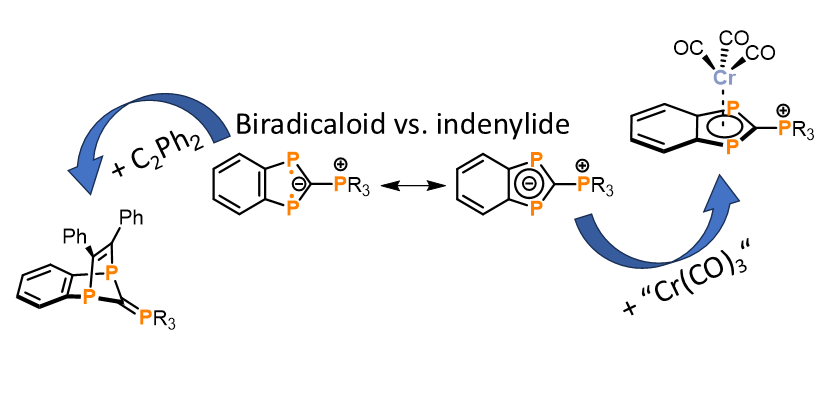
The synthesis of a phosphonium-substituted diphosphaindenylide, PPI, is reported. Introduction of two P atoms to the indenyl core results in considerable biradical character. Moreover, the ligand properties of PPI are investigated using a chromium tricarbonyl complex as model compound.
[01] Redox-chemistry of Pyramidanes: A DFT Study
P. Coburger,* Eur. J. Inorg. Chem. 2023, e202300596 (part of the collection “Inorganic Reaction Mechanisms”).
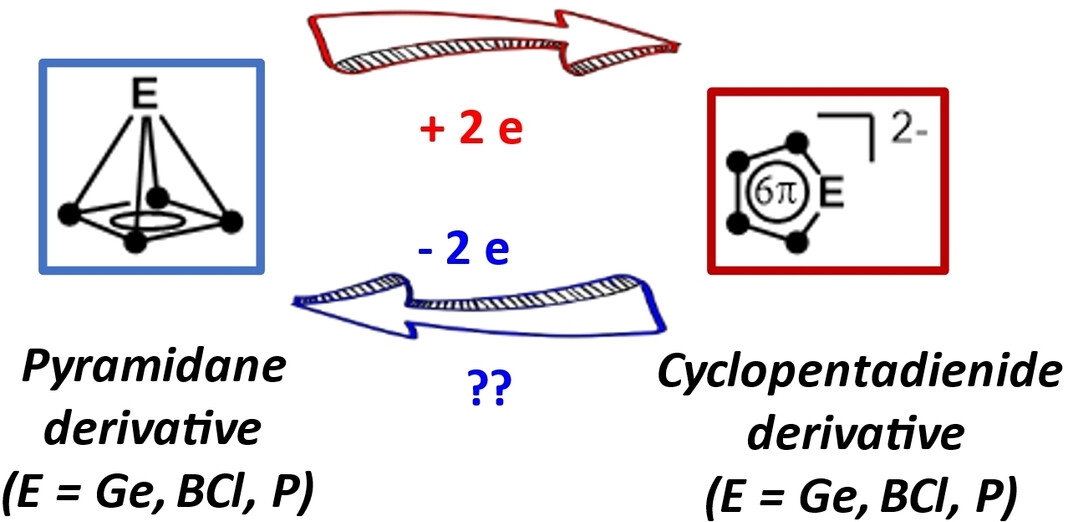
The reaction mechanisms for the reduction induced rearrangement of a series of pyramidanes into their cyclopentadienide derivatives were elucidated using density functional calculations. The calculations indicate that the reductions might proceed in a facile manner. However, the re-oxidation of the cyclopentadienide might yield meta-stable cyclic species. The latter represent intriguing synthetic targets.